
How to Get Paid Faster: A Tradie's Guide to Late Payers
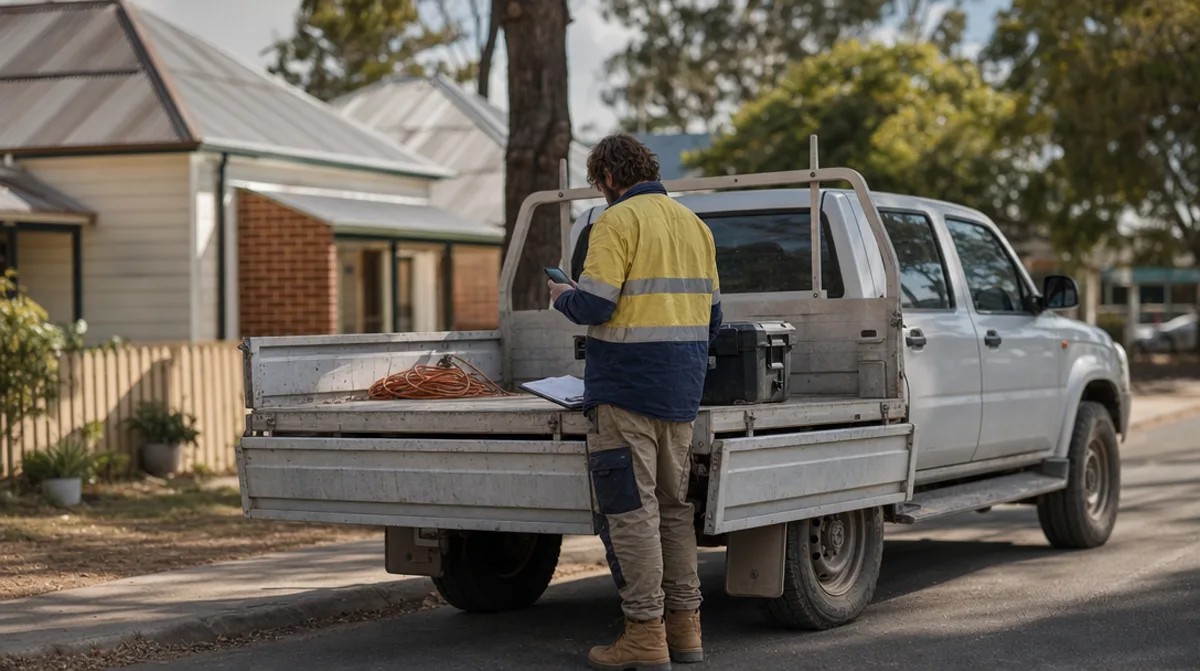
A trade business can be profitable on paper and still run out of cash, because the money is sitting in someone else's account. You did the work, sent the invoice, and now you're three weeks into a polite email chain while your supplier account and your BAS both fall due. Getting paid faster is rarely about chasing harder. It comes down to decisions made before the job starts: what your terms actually say, how much you hold before you turn up, when you claim, and how easy you make it to hand over the money. Fix those and most of the chasing disappears.
Set payment terms that suit your cash cycle, not theirs
"Net 30" is inherited from commercial invoicing, and on a domestic job it is free credit you are handing over. If your supplier account falls due on the 20th of the following month and your invoice sits for 30 days from issue, you are funding the customer's job out of your own working capital. For residential work, 7 days from the invoice date is standard and easy to defend. Payment on completion is normal for small service calls, so take the card before the van leaves. On commercial and builder work you will usually be handed their terms, so price that delay in rather than pretending it isn't there. Whatever you pick, put it on the quote, not just the invoice: terms that first appear after the work is done are terms nobody agreed to. And write the due date as a date, "Due 21 August 2026", rather than "Net 7", which invites interpretation.
Take a deposit, and check your state's cap first
A deposit covers your materials outlay and proves the customer is real. For general service work, size it to what you must buy before you start, and say so: "this covers the switchboard and cable" beats a bare percentage. Regulated building work is different, and the caps are legislated. In Victoria the maximum deposit on a domestic building contract is 10% under $20,000 and 5% at $20,000 or more. In NSW it is 10% of the contract price for residential building work. Queensland allows 10% on Level 1 contracts and 5% on Level 2 ($20,000 and over), with up to 20% where substantial customised work is prefabricated off site. Check your regulator before setting a house rule. On GST: unless you are holding a genuine security deposit you don't touch, a deposit is a part payment. On cash accounting the GST falls due when you receive it; on accruals, taking any payment or issuing the invoice pulls the GST for the whole job into that period. Don't spend the lot.
Break long jobs into progress claims
If a job runs longer than about a week, invoicing once at the end means carrying labour and materials the whole time. Tie each claim to a visible milestone rather than a calendar date, because milestones are hard to argue with: deposit on acceptance, rough-in complete, fit-off complete, final on practical completion. A bathroom might be 20% deposit, 30% at demolition and rough-in, 30% at waterproofing and tiling, 20% on completion. Write the schedule into the quote so the customer signs up to it, and issue each claim the day the milestone is hit, not at month end when the work has faded from memory. Subbies on commercial work should know their state's Security of Payment Act: every state and territory has one, and a properly made payment claim opens a statutory adjudication path faster and cheaper than court. Coverage varies, as NSW removed its owner-occupier exclusion in 2021 while Victoria still carves out builder-to-homeowner contracts, and the deadlines are short, so read yours before you need it.
Remove every excuse between the invoice and the payment
Bank transfer asks the customer to find the invoice, retype a BSB and account number and get the reference right. A card payment is a tap. Note what is changing: from 1 October 2026 surcharges are being removed on eftpos, Mastercard and Visa payments, debit and credit, so card costs belong in your rates and margins rather than as a line on the invoice. Most late payment is administrative rather than malicious: the invoice went to the wrong person, the purchase order number is missing, or your ABN isn't on it, and a business that cannot see your ABN must withhold 47% of payments over $75 excluding GST. Get the basics right: the words "tax invoice", your business name and ABN, the issue date, a description, the GST amount, and the customer's name or ABN once the total reaches $1,000. In Taskr the invoice carries a pay-by-card link and the payment lands against the job, so you aren't matching bank lines to jobs a fortnight later.
Automate the chase so it happens without you
Nobody follows up at 8pm after ten hours on the tools, which is exactly why invoices age. Make the follow-up a system instead of a decision. A workable rhythm: a friendly nudge three days before the due date, a short note on the due date, then follow-ups at 7, 14 and 21 days overdue, each one firmer. Keep the early ones warm and assume good faith, because most people genuinely forgot. From 14 days, write it so it reads like a record: invoice number, amount, original due date, and what happens next. At 21 days, ring them, because a two-minute call resolves what six emails can't. Favour SMS early on, since a text lands on the phone already in their hand while an email waits for them to open an inbox. Taskr chases overdue invoices automatically on a schedule you set, so the awkward day-7 reminder still goes out during the week from hell. Whatever you use, log every contact, because you will want that trail if this escalates.
Make interest and recovery costs actually enforceable
You can charge interest on overdue accounts, but only if the customer agreed to it before the work started. A line in the footer of an invoice sent after completion is not an agreement. Put it in the quote and terms: "Overdue accounts accrue interest at 10% per annum, calculated daily from the due date", plus a clause covering reasonable recovery costs. Keep the rate compensatory rather than punitive. Your terms are a standard-form contract, and the unfair contract terms regime now applies to consumer and small business contracts with penalties attached, so a rate that reads as punishment can be struck out and expensive to argue about. In practice the interest is rarely the point. "Interest starts accruing Friday" is a deadline with a consequence attached, which is more than a reminder email carries. Apply it consistently, or waive it explicitly as goodwill when they pay, which is a useful card to hold.
When they still won't pay: escalate in order
Work the ladder in order. First, a letter of demand: plain language, invoice details, a firm 7 or 14 day deadline and what you will do when it passes. Free templates are on state fair trading and legal aid sites. Send it by email and post. Second, use the free services. NSW Fair Trading, the QBCC and Domestic Building Dispute Resolution Victoria all run conciliation, and in Victoria you generally need a DBDRV certificate before VCAT will hear a domestic building dispute. The Australian Small Business and Family Enterprise Ombudsman helps with business-to-business disputes. Third, small claims: state tribunals and magistrates courts, including VCAT, NCAT and QCAT, hear claims up to a limit for modest filing fees and without a lawyer. Fourth, a debt collector, usually on commission of what they recover. There is no general builder's lien over property in Australia, so holding the job to ransom is not a strategy. If someone burns you once, ask for payment up front next time, or don't quote.
Track the one number that tells you it's working
The number that matters is the average days from invoice issued to money received. Add up those days for every invoice paid last quarter and divide by the number of invoices. Do it once and it's trivia; do it every quarter and it's a management tool. Above 30 days on residential work, one of three things is true: your terms are too loose, your reminders aren't firing, or you're invoicing late. Track the second number too, the days between finishing the job and issuing the invoice. That gap is entirely within your control and it is usually the biggest single delay in the cycle. An invoice raised on site the day you finish always beats one written on a Sunday night three weeks later, which is the point of speaking an invoice into your phone in Taskr before you pull out of the driveway. Start free, no card required.
Frequently asked questions
- What are standard payment terms for tradies in Australia?
- For residential work, 7 days from the invoice date is standard in Australian trades, and payment on completion is common for small service calls. Commercial clients and builders usually impose their own terms of 30 days or more, so price that delay in. State your terms on the quote as well as the invoice, and show an actual due date rather than "Net 7".
- How much deposit can I ask for on a job?
- For general trade work, size the deposit to the materials you must buy before starting. Residential building work is capped by state law: Victoria allows 10% under $20,000 and 5% at $20,000 or more, NSW allows 10% of the contract price, and Queensland allows 10% on Level 1 and 5% on Level 2 contracts. Check your state regulator, as caps change.
- Can I charge interest on an overdue invoice in Australia?
- Yes, but only if the customer agreed before the work began. The clause must appear in the quote or terms and conditions you supplied up front, because a line added to an invoice footer afterwards is generally not enforceable. Keep the rate compensatory, such as 10% per annum calculated daily from the due date, since a punitive rate can be challenged as an unfair contract term.
- What do I do if a customer refuses to pay?
- Escalate in order. Send a letter of demand with a firm 7 or 14 day deadline. For building work, use your state's free dispute service, such as NSW Fair Trading, the QBCC or Domestic Building Dispute Resolution Victoria, which is a required step before VCAT in most Victorian domestic building disputes. Then lodge a small claim at your state tribunal or magistrates court. A debt collector is the last resort.
- Can I still charge a card surcharge in Australia?
- From 1 October 2026, surcharging is removed on eftpos, Mastercard and Visa payments, covering debit, prepaid and credit cards, following the Reserve Bank's review of card payment costs. The cost of accepting cards then belongs in your hourly rate and margins rather than as a separate line on the invoice. Unrelated charges, such as call-out or weekend fees, are not affected.
Put this into practice with Taskr
Voice & photo quoting, live job costing, receipt scanning and Xero sync — built for Australian trade & service businesses. Every plan starts with a 14-day free trial.
Start 14-day free trial